The Nvidia DLSS 5 backlash was inevitable
Perhaps we'll need a Gamemaker mode soon
Gamers are up in arms over Nvidia’s latest DLSS 5 frame-gen technology, which moves into generative AI territory.
While previous DLSS iterations have enhanced games by upscaling lower-resolution content or added frames to improve performance, DLSS 5, which Nvidia CEO Jensen Huang hailed as the “GPT moment for graphics” is described as “blending hand-crafted rendering with generative AI”. It’s slated to roll out later this year in games like Hogwarts Legacy, Starfield, and The Elder Scrolls IV: Oblivion Remastered.
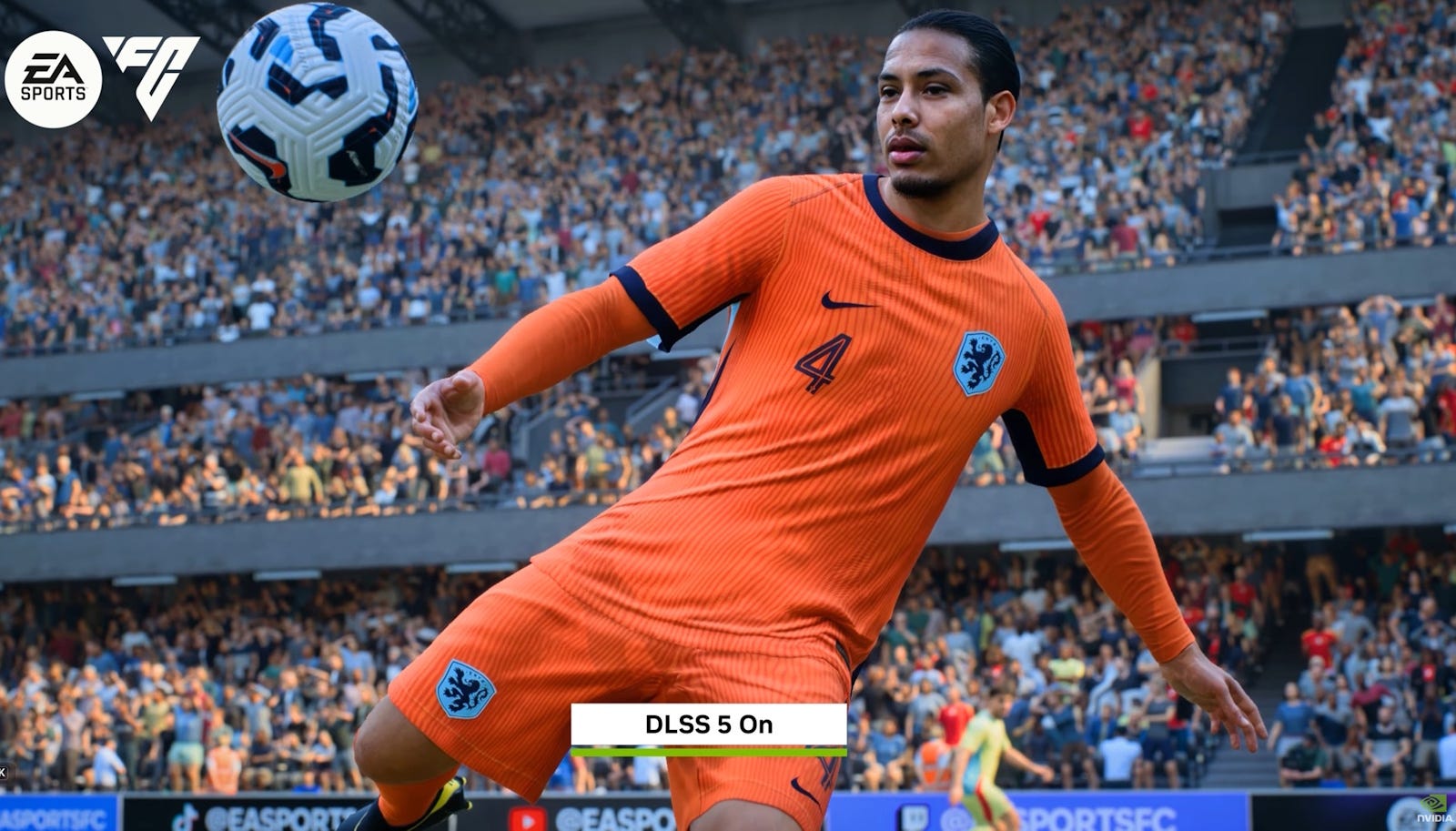
You can see DLSS 5 in action in the reveal video above, but TLDW, the result has been derided as AI slop by many. Resident Evil Requiem protagonist Grace, for example, seems to have gotten lip fillers and more defined cheeks. Or as someone puts it, the Mar-a-Lago face. I could barely recognise Liverpool captain Virgil van Dijk in EA Sports FC, though I would also admit that the original model (without DLSS 5) wasn’t that accurate in the first place. Basically, everything seems to be coated with this glossy, homogenized look that we often associate with AI slop.
And all for what? Photorealism?
Here’s the thing. Veteran gamers are used to games lacking a certain amount of realism. The technology wasn’t there in the past, but we still loved our games. The mind can fill in the blanks, and make something out of blocky pixels and good art direction.
I spent hundreds of hours in Elden Ring despite the graphics, which to be charitable, are passable at best. Sure, generative AI can make things look more realistic. Would DLSS 5 have air-brushed away the flawed charms of Elden Ring, making it look like another generic open-world RPG?
Nvidia was quick to point out that developers ultimately have the final say and control over how DLSS 5 is used. But the reality is not as clear-cut. If a game studio has paid to use the feature, you can bet that the executives will want their artists to use it. For example, modern games are increasingly unoptimised, partially due to increased complexity, but also because developers know that DLSS could boost the performance. And Nvidia’s dominant market share in graphics means that most PC gamers will have some version of DLSS.
Of course, Jensen Huang said that the critics are wrong. But come on, read the room. For PC gamers, the AI boom (and the resulting RAM shortage) has only made their hobby more expensive. So he can’t be surprised if some gamers are bashing the use of generative AI in DLSS 5.
Perhaps what we need is something like Filmmaker mode in TVs, which aims to preserve the creator’s intent by turning off some of the TV’s processing. A Gamemaker mode that disables the use of generative AI in games for the things that matter. Keep DLSS 5 to just the game environments, not character models.
This week, we checked out Dyson’s new slim wet floor cleaner, tested the handy Asus Zenbook S14 laptop, and played the latest Pokemon Pokopia game.
The Dyson PencilWash is very slim and portable, though because it comes in two parts (the stick with the battery and the cleaner head), it actually takes up more space than the Dyson Clean+Wash when charging. You also have to manually clean the PencilWash’s cleaner head after every session. But it is competitively priced at S$499, and does a good cleaning job.
The Asus Zenbook S14 (UX5406) is a premium 14-inch laptop that’s portable (1.2kg) and has a unique ceramic-blended aluminium lid that looks good, and is fairly resistant to smudges. It also packs the latest hardware, including a new Intel Core Ultra 9 processor that will have no issue running all your office apps. Battery life is excellent, but the laptop is pricey (S$3,299).
The new Pokemon Pokopia is a delightful blend of Animal Crossing, Minecraft, and Pokemon. Set in a future where the humans are gone, this life simulation game sees you play as a Ditto, who will have to be the substitute human, and assist other Pokemons by building habitats and helping them out with various quests. There are 300 Pokemon that you can find and befriend, and lots of content that justify the game’s S$100 price tag.


