Jabra Evolve3 headsets more consumer-friendly than before
Latest evolution of Jabra's headsets for hybrid professionals
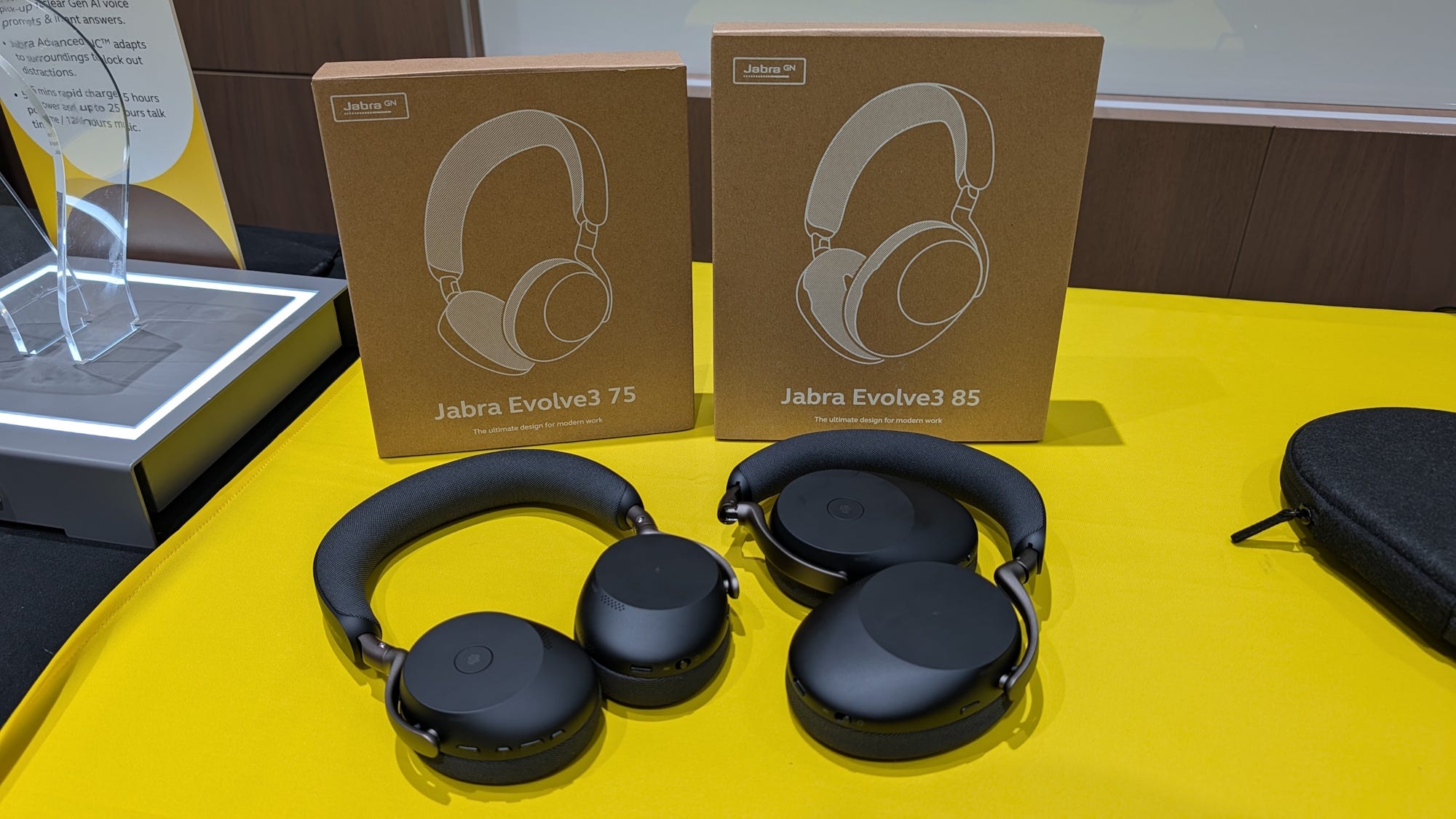
Jabra may have abandoned the consumer audio space back in 2024, but its latest Evolve3 85 and Evolve3 75 headsets don’t stick out like a sore thumb (or should I say boom arm) when placed next to Sony or Bose headphones.
Yes, the boom arm found in the previous Evolve2 headsets is gone in the new versions. Instead, these headphones rely on AI and multiple concealed microphones to ensure your voice remains clear even in busy environments. Now you could always hide the boom arm in the older headsets, but that would also mute the microphone.
Like before, the higher-end and more expensive Evolve3 85 is an over-ear headset while the Evolve3 75 has an on-ear design. Both Evolve3 headsets have also switched from leatherette, which was susceptible to flaking and peeling, to fabric ear cushions. The new ear cushions are also more breathable and usable in Singapore’s climate.
That’s important because Jabra wants you to feel comfortable wearing these headsets outside the office. Not only are the new models lighter than before, you can fold them into a more compact, travel-friendly form that fits in the new, flatter carrying case. It helps that these headsets look premium. You wouldn’t mistake them for the inexpensive headsets used by call centres.
Battery life, too, has improved significantly, with Jabra quoting up to 120 hours and 110 hours of media playback with ANC off for the Evolve3 85 and Evolve3 75 respectively. In comparison, the Evolve2 75 was rated at just 36 hours with ANC off.
Then again, it’s been almost five years since the Evolve2 75 was introduced. And the world isn’t the same. For example, companies are no longer just paying lip service to sustainability. Jabra, too, has made tweaks — the battery and ear cushions are user-replaceable — to extend the longevity of the Evolve3 headsets.
Then there’s AI, of course. Jabra says it has trained its algorithm on a deep neural network fed with around 60 million sentence examples so that it will be able to better make out what you’re saying. And the headsets will also have Windows Copilot integration — a world’s first — via the Teams button at the side of the headset in a future update.
Having tried previous Jabra Evolve2 headsets, we are pretty confident that the new versions will turn out great, especially for voice calls and comfort. The Jabra Evolve3 85 and Evolve3 75 are available now in Singapore at an MSRP of S$890 and S$688 respectively. However, they are currently selling for much less on Jabra’s official Lazada and Shopee stores. The Evolve3 85, for example, is in the S$500 range, while the Evolve3 75 is around S$440. Sounds like a sweet deal at these prices.
This week, we tested DJI’s first robot vacuum, which comes in this cool, transparent design. We also fried up a storm using Ninja’s Crispi air fryer, and compared Samsung’s mid-range Galaxy A57 smartphone against the competition.
DJI’s first robot vacuum grabs your attention with a cool transparent design. But the actual performance is merely decent. While it didn’t get lost or stuck during our testing, it didn’t seem to understand how to handle some obstacles. The mop heads also smelt mouldy after a few uses that couldn’t be removed despite drying them as best as we could. On top of that, the DJI Romo P is pretty pricey at S$1,729.
The Ninja Crispi FN101 is more versatile than the typical air fryer. For one, it can cook for six or just for two, depending on the size of the glass baskets used. These baskets also double up as a serving dish, and come with a lid for storage. This air fryer is also easy to use, though cleaning the grate, where grease can accumulate, can be tricky. However, it’s a bit more expensive than other air fryers at S$299.
The Samsung Galaxy A57 5G (from $598) is a mid-range model that doesn’t do enough against similarly-priced smartphones from Chinese brands to justify its price. In fact, the price has crept up, which isn’t surprising given the current economic climate. But the Galaxy A57 only has incremental hardware gains over last year’s model, while key features like battery capacity remain unchanged. The cameras, too, are looking dated.


